


With the passage of the Growth Opportunities Act in 2024, the phased introduction of electronic invoicing (e-invoicing) in Germany was approved. This will fundamentally change the way invoices are exchanged between domestic companies. The goal is to further digitize and standardize invoicing processes and, in the future, to link them to digital reporting procedures (ViDA).
The e-invoicing requirement applies exclusively to business transactions between companies (B2B).
An electronic invoice (e-invoice) is an invoice that is created, transmitted, received, and archived in a structured, machine-readable data format. This allows the invoice data to be automatically read and processed by software. In Germany, e-invoices must generally meet the requirements of the European standard EN 16931. Common formats for this include XRechnung and ZUGFeRD. However, other formats that are interoperable with the EN 16931 standard are also permitted.
PLEASE NOTE: Under the new German value-added tax law, a PDF-only invoice is considered a “standard invoice” and not an e-invoice.
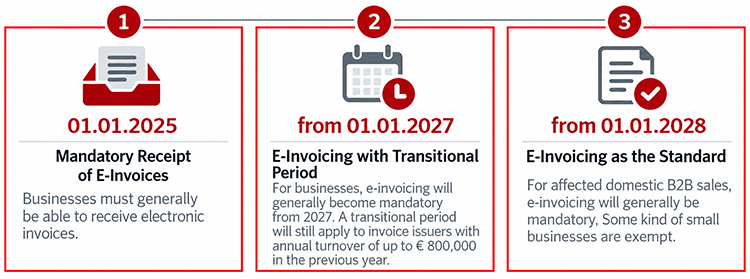
Receiving e-invoices has been mandatory for domestic companies since January 1, 2025.
Transitional rules apply to the sending of electronic invoices: As of January 1, 2027, e-invoicing will generally be mandatory for applicable domestic B2B transactions. Companies with prior-year revenue of up to €800,000 are exempt from this requirement. For them, this requirement takes effect on January 1, 2028.
Outgoing invoices, incoming invoices, posting, and archiving—in WinLine, you can process your electronic invoices end-to-end in a single system:
(Videos in German)
In future, e-invoices will be issued in a structured electronic XML format, based on the EU standard EN 16931. This uniform standard enables the electronic receipt, transmission and processing of invoices.
Invoices in PDF format no longer fall under the definition of an electronic invoice, but are classified as ‘other invoices’.
The ViDA (VAT in the Digital Age) project was launched by the European Commission. It proposed a series of measures to modernize the current value-added tax system in the European Union in order to combat tax fraud.
Among other initiatives, the project includes the mandatory use of electronic invoices in cross-border transactions and the introduction of digital reporting requirements (DRR).
If domestic B2B sales meet the following criteria, an electronic invoice must be issued for them:
Regardless of the transitional rules that have been adopted, there are some exceptions where there is generally no obligation to issue an e-invoice. These include, for example,
For details, we recommend consulting with your tax advisor.

Receiving e-invoices has been mandatory since January 1, 2025. In WinLine, incoming invoices can be recorded, verified, approved, and transferred directly to financial accounting for posting using the WinLine VOUCHER PRO module. Finally, invoices are stored in an audit-proof, legally compliant manner in WinLine ARCHIVE, WinLine’s document management system. When integrated with WinLine CRM, the entire invoice receipt process can be fully automated.
All you need to receive an electronic invoice is an email inbox. You can easily import the invoice into WinLine using drag-and-drop.

Electronic outgoing invoices will be phased in by January 1, 2028. They are created using the WinLine eBILLING module and sent directly from WinLine in compliance with the EN 16931 standard, in the standard formats XRechnung or ZUGFeRD/Factur-X. These invoices are also ultimately stored in an audit-proof manner in the WinLine ARCHIVE, which meets the requirements for the immutability of electronic invoices.
WinLine VOUCHER PRO is used to receive and process e-invoices in WinLine ACC1 and WinLine ACC2.
In WinLine ACC2, electronic invoices are sent with WinLine eBILLING. This also includes the ‘XRechnung’ and ‘ZUGFeRD (Factur-X)’ standards commonly used in Germany. Areas of application for this include transactions with public authorities or organisations. The European standard EN 16931 used therein is forward-looking at B2B level according to the German federal government.
You have several options for ensuring receipt, processing and dispatch with the WinLine. Talk to your mesonic partner and decide together which option is right for your company.
In Austria, e-invoicing is currently mandatory only in the B2G sector—that is, for invoices sent to the federal government, states, and municipalities. Structured formats such as ebInterface or Peppol are accepted.
For purely domestic B2B transactions, the implementation date for electronic invoices in Austria has not yet been determined. Currently, e-invoices are not mandatory in this context. However, due to the legal requirement for e-invoicing in Germany, pressure on Austrian companies to issue and receive structured electronic invoices is growing, with the result that many companies are already using e-invoices today.

The Association for Electronic Invoicing (VeR) is the expert association for electronic invoice exchange. It brings together the expertise of software providers, platform operators, service providers, and others, and advocates for uniform standards and secure processes related to electronic invoicing. The association has been supporting the introduction of e-invoicing and the development of digital reporting systems in Germany for over 15 years.
As a member, we benefit from direct interaction with industry experts and up-to-date information on technical and legal developments. This knowledge is directly incorporated into the ongoing development of our WinLine. As a result, you benefit from practical solutions that enable you to manage your electronic invoice processing efficiently, securely, and with an eye toward the future.


